Data Ownership Is Not a Document — It Is a Discipline
- 3 days ago
- 2 min read
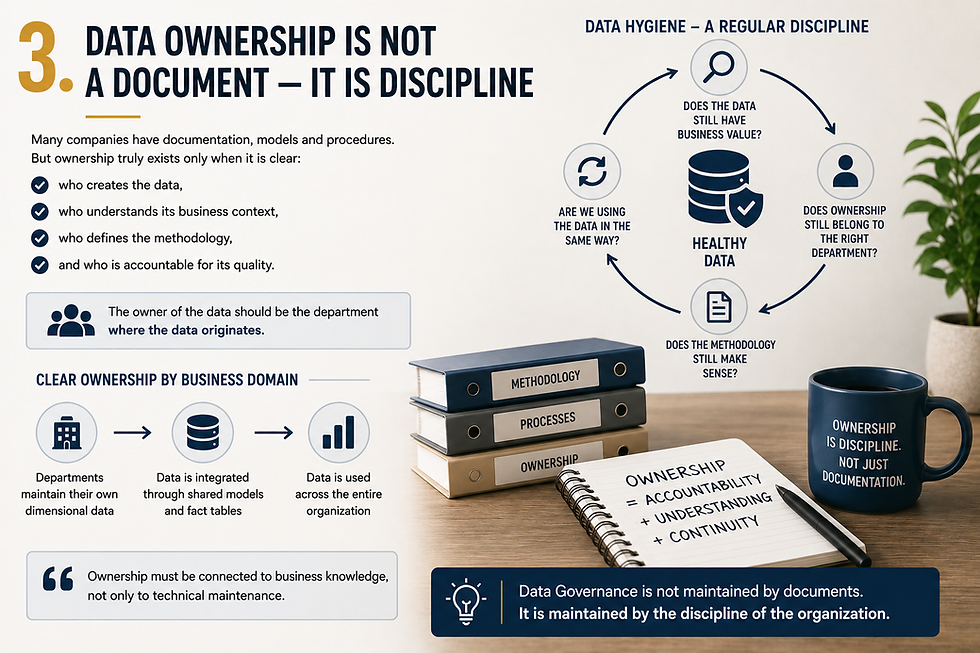
Today, many companies already have:
Data Governance documentation,
defined procedures,
RACI matrices,
ownership models,
and various data management policies.
But in practice, that often does not mean ownership truly works.
Because ownership is not just a document.
Ownership is the way an organization understands responsibility for its data.
The biggest problem appears when companies treat ownership as a purely formal exercise — something that only needs to be written inside a governance file or organizational chart.
In reality, ownership exists only when it is clear:
who creates the data,
who understands its business context,
who defines the methodology,
and who is accountable for its quality.
In my opinion, the owner of the data should be the department where the data originates.
Sales should own sales data.
Logistics should own logistics data.
Operations should own operational data.
There should not be a separate department mechanically maintaining data without fully understanding the business process behind it.
People who work daily within a specific domain are far more likely to recognize when data simply does not make sense.
That is why ownership must be connected to business knowledge — not only to technical maintenance.
One of the major problems in organizations appears when core tables contain data coming from multiple departments without clear ownership boundaries.
A much healthier approach is when:
each department maintains its own dimensional data,
ownership is clearly defined by business domain,
and integration happens later through shared models and fact tables.
This allows ownership to remain clear even when data is used across the entire organization.
But even a good structure is not enough by itself.
Data and ownership models must be reviewed periodically.
Many organizations spend years maintaining:
columns nobody uses anymore,
outdated reports,
unnecessary tables,
and ownership models that no longer reflect reality.
That is why data should regularly go through a form of “data hygiene”:
does this data still provide business value,
does ownership still belong to the right department,
does the methodology still make sense,
and is the organization still using the same data consistently?
Because Data Governance is not maintained by documents alone.
It is maintained through organizational discipline:
clearly defining accountability,
continuously reviewing processes,
and actively maintaining data quality over time.
Real ownership does not begin when a document is written.
Real ownership begins when organizations stop saying:
“We’ve always done it this way”
and start asking:
“Does this process still make sense today?”


Comments