The Data Is Correct. The Decision Is Still Wrong.
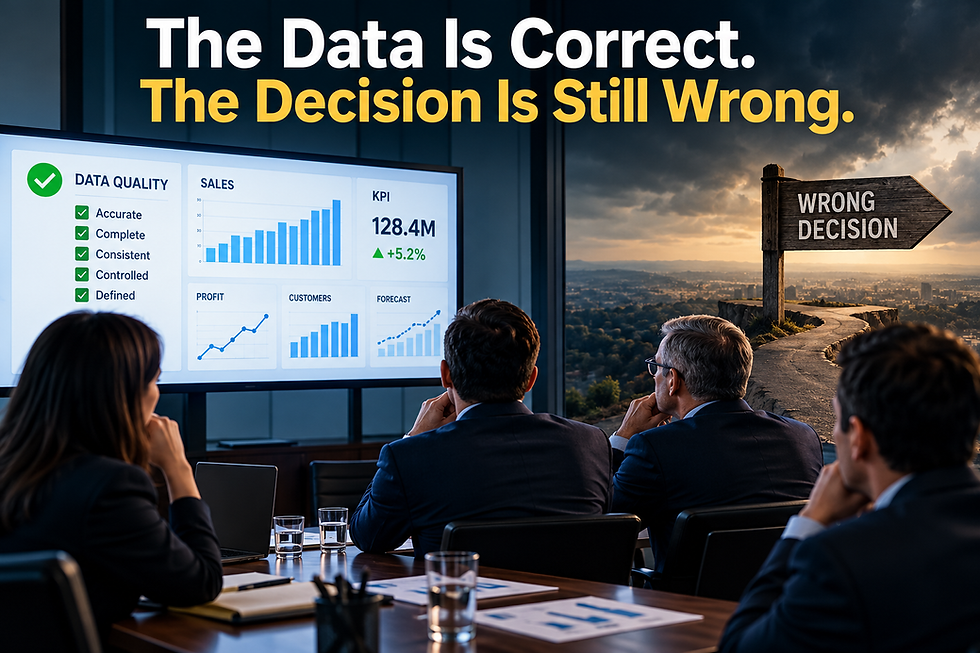
Sometimes the data is completely correct.
The dashboard works.
The KPI definitions are clear.
The lineage is known.
The controls are in place.
And the business still makes the wrong decision.
That does not automatically mean Data Governance failed.
This distinction is important because organizations often expect Data Governance to do more than it actually should.
The purpose of Data Governance is not to guarantee that every business decision will be successful.
Its purpose is to make sure that decisions are based on data that is accurate, controlled, understood and properly defined.
The future is still uncertain.
A company can analyze the right numbers, use the correct KPIs and still open a store that performs badly.
A forecast can be built on high-quality data and still be wrong.
Market conditions can change.
Customer behavior can change.
A competitor can enter the market.
Something completely unexpected can happen.
None of that automatically makes it a Data Governance problem.
The responsibility of Data Governance ends where business interpretation begins.
That boundary must be clear.
Data Governance should make sure that every important KPI has a precise definition.
It should maintain the Business Glossary.
It should understand Data Lineage.
It should ensure that critical data is controlled and that quality issues are detected.
But Data Governance does not need to be an expert in every business function.
A Data Governance professional does not need to understand commercial strategy better than the commercial team.
They do not need to decide which period should be used for a sales forecast.
They do not need to determine which assumptions belong in a financial model.
That is the responsibility of the people who own those business decisions.
If Commercial decides that the forecast should use the last six months, that decision belongs to Commercial.
If BI builds the model according to those requirements, responsibility for the analytical logic belongs to the relevant analytical and business teams.
Data Governance should make sure the underlying data is reliable.
That is a very different responsibility.
The same applies to KPI interpretation.
If a KPI is poorly defined or its meaning is unclear, Data Governance may have a problem.
But if the definition is correct, documented and available, and users simply do not understand how to apply it, that is no longer purely a Data Governance issue.
Business functions and their managers are responsible for making sure their teams understand the tools and information they use.
Training may be required.
Additional education may be required.
But Data Governance cannot replace line management.
That is also why Data Governance needs strong support from top management.
Policies, glossaries and controls have little value if business teams can simply ignore them.
A governance framework only works when the organization expects people to use it.
There is, however, one important situation where Data Governance must intervene immediately.
When the data itself is known to be wrong.
Imagine that a daily Data Quality control identifies a critical issue in a data point that feeds an important management report.
The meeting where the report will be used starts in two hours.
At that point, the discussion should not be about whether management is willing to accept the risk.
The report should stop.
The critical data should be corrected first.
For non-critical issues, the approach can be different.
A minor problem that does not affect the decision can be corrected while the process continues.
Not every Data Quality issue should stop the business.
But critical data is different.
If the organization knows that a critical number is wrong, there should be no exception simply because a decision is urgent.
Waiting two hours is not a serious problem.
Even waiting two days may be reasonable.
One major decision made on incorrect data can cost much more.
This is why Data Quality control should not happen only before an important forecast, investment decision or management meeting.
It should happen every day.
Good Data Governance should create an environment where the organization already knows the current quality of its critical data.
It should not need a special “fit for purpose” exercise every time someone wants to make a decision.
Data quality should be an ongoing state, not an emergency check.
This also creates a clear division of responsibility.
Data Governance is responsible for definitions, lineage, controls and data quality.
BI and Analytics are responsible for implementing analytical models and calculations.
The business is responsible for assumptions, interpretation and the final decision.
Those responsibilities should not be mixed.
Because if Data Governance starts deciding which commercial assumptions are correct, it is no longer governing data.
It is trying to run the business.
And if the business expects Data Governance to guarantee that every decision will be successful, it is asking for something that data can never provide.
Good data improves the quality of a decision.
It does not remove uncertainty.
The data can be correct.
The decision can still be wrong.
And sometimes that simply means the organization made a business decision in an uncertain world.
That is not a failure of Data Governance.
A Data Governance failure begins when the organization makes that decision using data that it already knows it cannot trust.


Comments