We Have Data. But Do We Trust It?
- May 14
- 1 min read
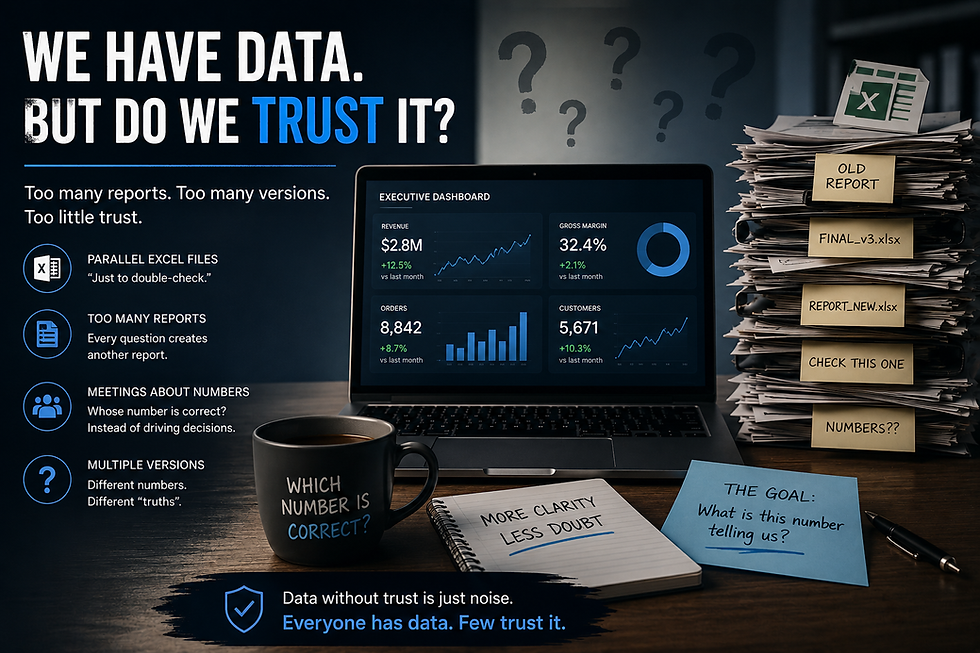
Modern companies have more data than ever before.
Dashboards.
KPIs.
Power BI reports.
Data warehouses.
And yet, many organizations still struggle with one simple problem:
They do not fully trust the data they are looking at.
You can usually recognize this very quickly.
People keep parallel Excel files “just to double-check.”
Old reports continue to exist next to modern BI systems.
Meetings become discussions about whose numbers are correct instead of discussions about business decisions.
One of the clearest signs that trust in data is missing is when organizations constantly validate reports manually, even after investing heavily in reporting platforms and centralized data warehouses.
At that point, the problem is no longer technical.
It becomes cultural.
Many companies today also suffer from reporting overload.
Every new business question creates:
another dashboard,
another KPI,
another report,
another version of the truth.
And eventually, organizations get lost in their own reporting ecosystem.
Because a KPI alone means very little if it is not connected to the broader business context and correlated with other indicators.
That is usually the moment when managers start discussing the fourth decimal point while losing sight of the actual business problem.
And that is where organizations slowly begin to lose focus.
The real goal of Data Governance is not to constantly ask:
“Is this number correct?”
The real goal is to confidently ask:
“What is this number telling us?”
Because in the end:
Everyone has data. Few trust it.


Comments