Data Governance Is Not Documentation — It Is a Way of Working
- May 2
- 2 min read
Updated: May 7

When people hear Data Governance, they often think about:
procedures,
policies,
documentation,
ownership matrices,
and additional administration.
But in reality, the biggest problem is usually not the lack of documentation.
The real problem is that many rules are never operationally applied.
You can have a perfect framework on paper and still have terrible data in your systems.
I often compare this to laws.
You can create the best law imaginable, but if there is no way to enforce it in practice, its value becomes very limited.
The same applies to Data Governance.
The Biggest Misconception About Data Governance
Companies often expect quick results:
better reporting,
fewer errors,
more accurate KPIs,
greater trust in data.
But real Data Governance is a long-term process.
Not because it is complicated on paper, but because it requires changing the way the entire organization works.
On the other hand, employees often see Data Governance as:
“just another additional task.”
In reality, the goal should be the exact opposite.
Data Governance is not there to make people’s jobs harder.Its purpose is to establish clear rules:
how data should be entered,
what specific data actually means,
and how the same data should represent the same thing across the organization.
When Nobody Trusts the Data Anymore
The most dangerous situation is not when a company lacks data.
The most dangerous situation is when:
everyone has data, but nobody trusts it.
That is when organizations start creating:
parallel Excel files,
multiple versions of the same reports,
manual validations,
and endless discussions about whose numbers are correct.
Eventually, important business decisions begin to rely on unreliable information.
And that is not just a technical issue. It is a serious business risk.
Poor Controls Can Be Just as Dangerous as No Controls
One of the most common problems in real-world Data Governance processes is poorly designed validation controls.
Especially when there are too many false positives.
If a system constantly reports issues that are not actually real problems, people eventually stop paying attention.
And then the worst thing happens:
fake issues get ignored,
but real issues get ignored as well.
A control that users no longer trust quickly loses all value.
Data Governance Is Not a Project That Ends
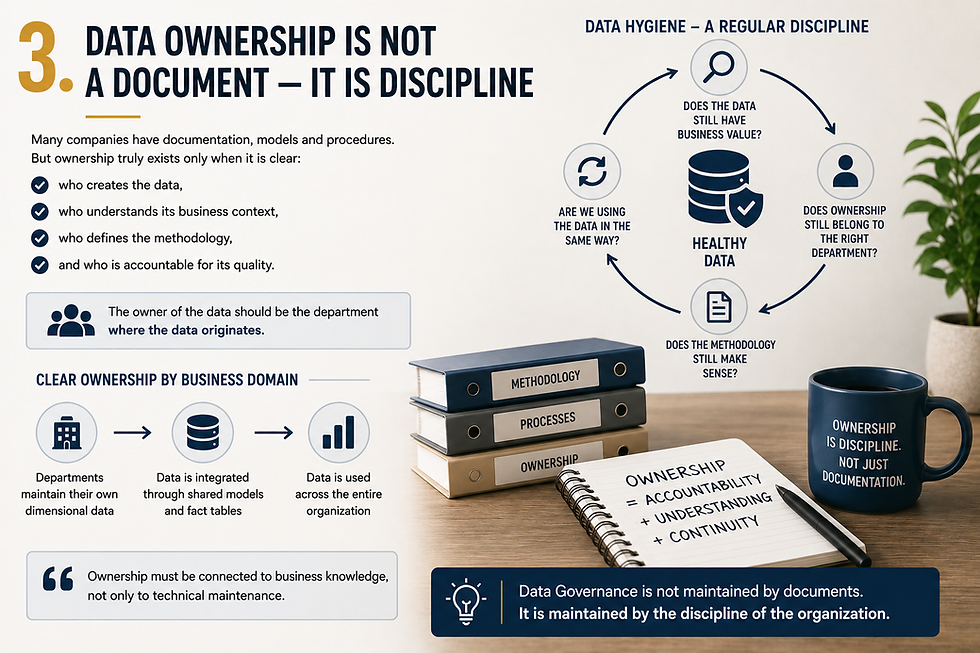
Data Governance is not a checklist. It is not a set of meetings and documents.And it is not a project that eventually reaches a “final version.”
It is a way of working.
Only when:
people understand why data matters,
responsibilities are clearly defined,
controls make sense,
and the organization trusts its own data,
can a company truly say it is becoming a data-driven organization.


Comments